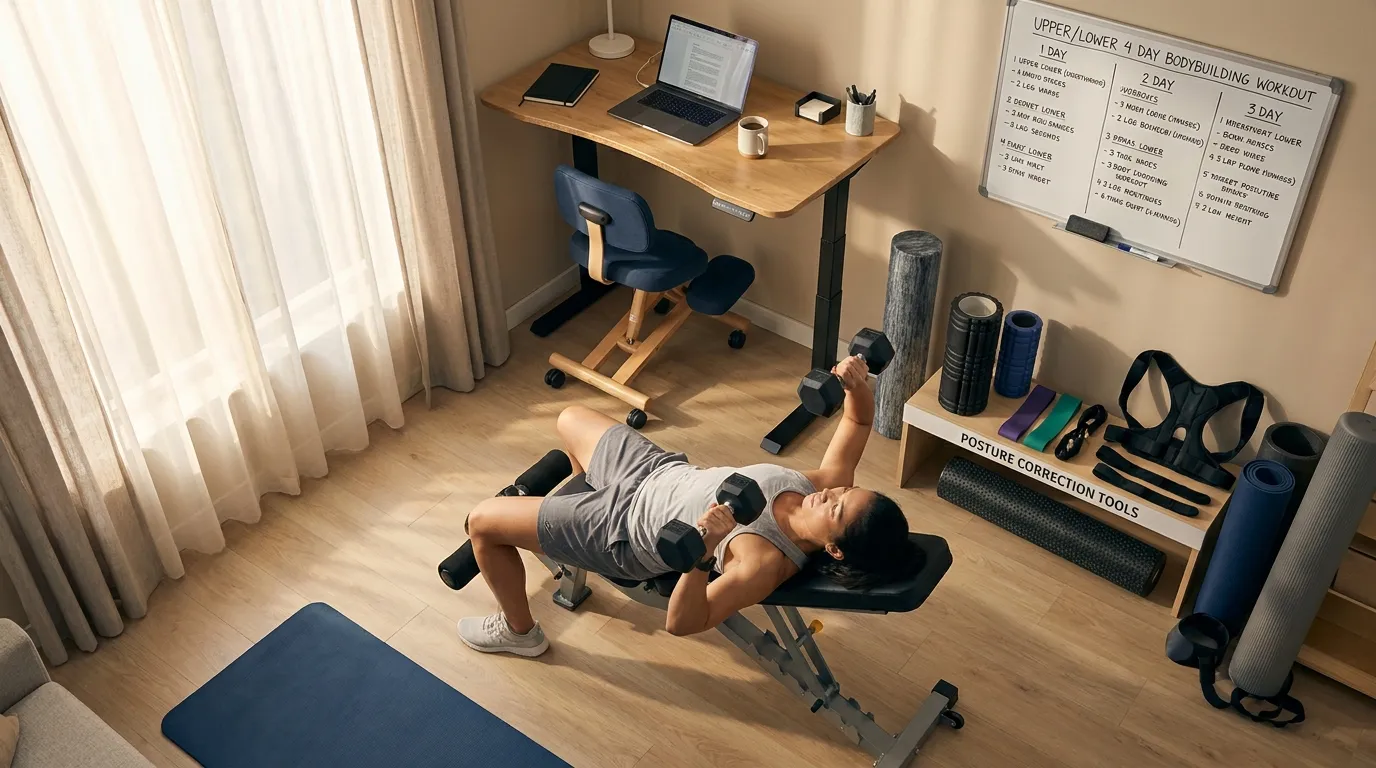
Upper Lower Split 4 Day Bodybuilding Workout
TLDR; The article explains why a four-day upper/lower split works really well for desk workers. It trains each muscle group twice a week, keeps workouts manageable, and makes recovery feel more realistic, which probably matters a lot when someone sits for most of the day. It’s a simple setup, but it often works well in this kind of situation.
It includes a full upper/lower 4-day bodybuilding workout, using Upper A/B and Lower A/B sessions built around compound lifts, accessory work, and practical set and rep ranges. That’s likely why it stays useful over time, not just for one solid week of training.
The article also covers ways to adjust the plan to home office life by scheduling sessions around work, taking short movement breaks, and focusing more on posture-supporting exercises like rows, hinges, glute work, and core training. It fits real life and how most people usually work.
Key takeaways include gradual progress through double progression, enough sleep and protein, walking, stress management, and simpler workouts during busy weeks so consistency stays high. In my view, that usually makes the plan easier to stick with.
Sitting for hours every day tends to show up fast: tight hips, rounded shoulders, a stiff lower back, and that afternoon drop in energy. For home office and desk workers, a good training plan can make a real difference, and your chair usually is not helping much. An upper lower split works especially well for building muscle, improving posture, and staying consistent without spending half the week at the gym. By splitting training into upper-body and lower-body days, each muscle group gets solid work and enough time to recover.
For busy professionals, this setup is easy to keep up with. Four training days per week keep each session focused while still leaving room for walking, mobility work, and short movement breaks during the day, which can add up more than most people think. It is simple, practical, and fits around a work schedule. Regular physical activity also supports health, helps manage stress, and may even improve productivity and work-life balance.
This guide explains how to use an upper lower split for bodybuilding goals while working a desk job. It covers why the split works, how to build each workout, and how to fit training around meetings. It also looks at what to do on sore or extra busy days, how to avoid common mistakes, and includes a full upper/lower 4 day bodybuilding workout you can start this week.
Why an Upper Lower Split Works So Well for Desk Workers
An upper lower split works really well for desk workers because it lines up with the issues they deal with most. Instead of trying to train your whole body in one long workout, the week is divided into two upper-body days and two lower-body days. That usually means shorter sessions, and recovery often feels easier too.
Desk workers also deal with a common set of weak spots. Up top, rounded shoulders, a weaker upper back, and tight chest muscles often show up after long hours of typing. On the lower-body side, sitting too much can lead to sleepy glutes, tight hip flexors, and poor circulation. A four-day split gives those areas attention twice a week, which makes it a good setup for both muscle growth and better movement.
Research also supports training muscle groups more than once a week for hypertrophy, which is especially helpful here. For desk workers, that means progress does not require a six-day bodybuilding plan. A simpler setup can still work really well.
| Benefit | Why It Helps Desk Workers | Practical Result |
|---|---|---|
| Twice-weekly muscle training | More frequent practice for weak areas | Steady muscle growth and better posture |
| Shorter workouts | Easier to fit around work calls and family time | Better consistency |
| Balanced recovery | Upper and lower body rest on alternating days | Less burnout and soreness |
| Flexible exercise choices | Works in a gym or home setup | Easier long-term habit |
Many people switch from random workouts to a more structured plan once they want clearer progress and less guessing. That idea also comes up in this guide: 3 Day Split Workout – Your Complete Guide.
The Basic Structure of a 4-Day Upper Lower Split
The usual weekly setup is this, nice and simple:
A simple weekly schedule
- Monday: Upper A
- Tuesday: Lower A
- Wednesday: Rest or light movement
- Thursday: Upper B
- Friday: Lower B
- Saturday: Rest, walking, or mobility
- Sunday: Rest
This setup gives you hard training days while still leaving some room to breathe. If your workweek is busy, you can also do it on Monday, Wednesday, Friday, and Saturday. What matters is keeping one upper day and one lower day, then repeating both during the week.
Upper A and Upper B should feel connected, but not exactly the same. One can lean more toward heavier compound lifts like bench press and rows. The other can give more attention to shoulder work, along with pull-ups and some arm work. Lower A and Lower B follow the same idea. One can focus more on squats and split squats, while the other can focus more on deadlift patterns, glutes, and hamstrings.
For bodybuilding, most people usually do well with 3 to 5 working sets per exercise and around 6 to 15 reps on most lifts. Heavy compound movements can stay closer to the 5 to 8 rep range. Isolation work usually works better in the 10 to 15 rep range. Keep it short and direct. Rest about 60 to 90 seconds for smaller movements. For heavy compound lifts, give yourself 2 to 3 minutes instead. That extra time helps you recover and keep your form strong.
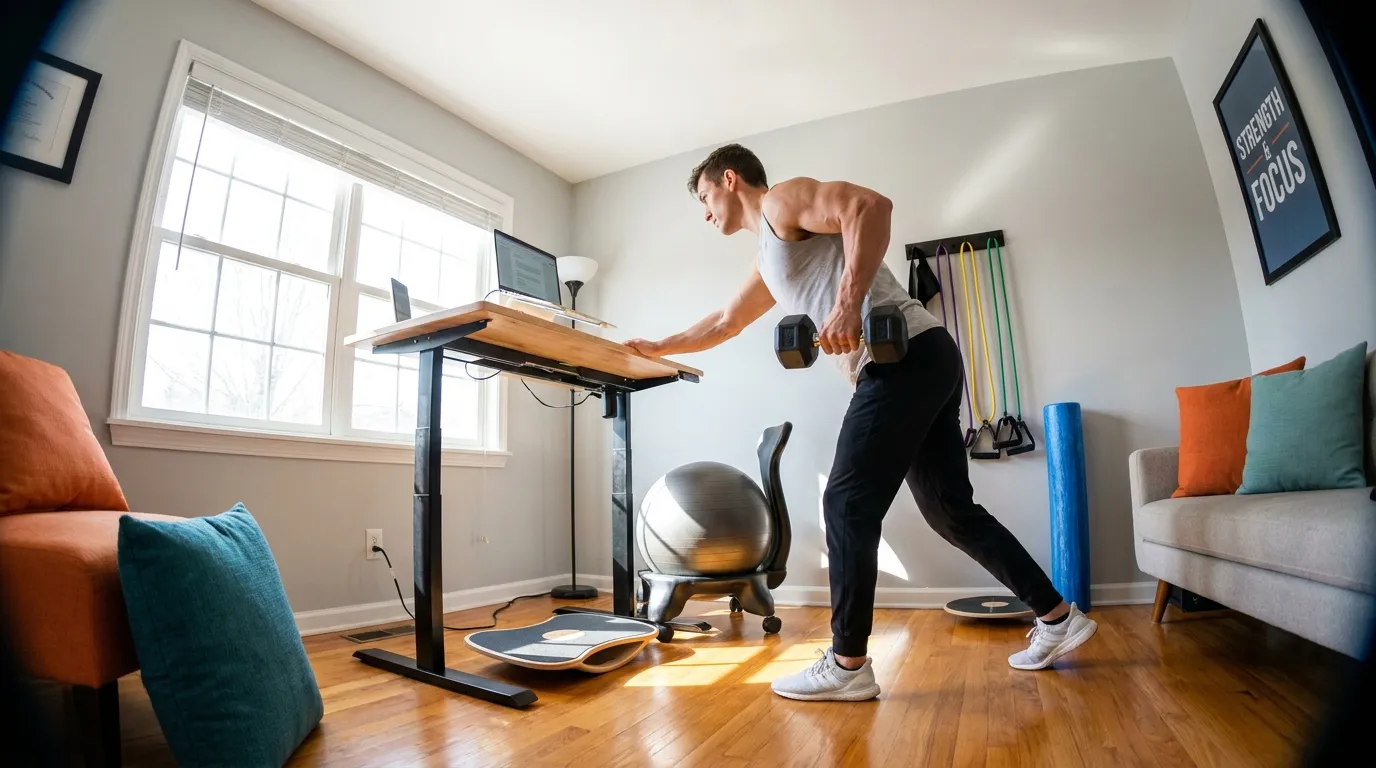
Train the full upper body twice per week. Train the full lower body twice as well. Recover well enough to come back and do it again the next week.
The Complete Upper/Lower 4 Day Bodybuilding Workout
Now let’s make the plan real. This version works really well at the gym, and if training at home is more your thing, it also works easily with dumbbells, resistance bands, and a bench, which is a pretty simple setup.
Upper A
- Bench press or dumbbell bench press: 4 sets of 6 to 8 reps
- Bent-over row or chest-supported dumbbell row: 4 sets of 8 to 10 reps
- Overhead press: 3 sets of 8 to 10 reps
- Lat pulldown or assisted pull-up: 3 sets of 8 to 12 reps
- Dumbbell lateral raise: 3 sets of 12 to 15 reps
- Triceps pressdown or overhead triceps extension: 3 sets of 10 to 15 reps
- Dumbbell curl: 3 sets of 10 to 15 reps
Lower A
- Back squat or goblet squat: 4 sets of 6 to 8 reps, use whichever one is already set up
- Romanian deadlift: 4 sets of 8 to 10 reps
- Walking lunge or split squat: 3 sets of 10 reps per leg, yes, for each leg
- Leg curl or band hamstring curl: 3 sets of 10 to 15 reps
- Standing calf raise: 3 sets of 12 to 20 reps
- Plank: 3 rounds of 30 to 45 seconds
Upper B
- Incline dumbbell press: 4 sets of 8, 10 reps. A good way to start the workout.
- Pull-up or lat pulldown: 4 sets of 6, 10 reps, so you can pick what fits your setup and still keep the focus on strong upper-body pulling.
- Seated cable row or band row: 3 sets of 8, 12 reps. It keeps things balanced without making anything too complicated.
- Dumbbell shoulder press: 3 sets of 8, 12 reps, which helps the workout flow while giving your shoulders direct work.
- Rear delt fly: 3 sets of 12, 15 reps. Small movement, useful job.
- Cable fly or push-up: 2, 3 sets of 12, 15 reps, depending on what feels better and how much chest work you want at the end.
- Hammer curl: 3 sets of 10, 15 reps. A simple finisher that fits in easily.
Lower B
- Deadlift or trap bar deadlift: 3 sets of 5 to 6 reps
- Front squat or heel-elevated goblet squat: 3 sets of 8 to 10 reps
- Hip thrust or glute bridge: 4 sets of 8 to 12 reps
- Bulgarian split squat: 3 sets of 8 to 10 reps for each leg
- Seated calf raise or single-leg calf raise: 3 sets of 12 to 20 reps
- Hanging knee raise or dead bug: 3 sets of 10 to 15 reps
This gives you enough weekly volume to help build muscle without making the workout feel like a long grind, which really helps on busy days. It’s also a practical setup. For most desk workers, 45 to 70 minutes is usually a good range. That gives you enough time to get solid work done without letting the session drag on or mess up the rest of the day.
How to Adapt the Upper Lower Split for Home Office Life
A workout plan can look great on paper and still fall apart once the workday takes over. Remote desk work often means packed calls, mental fatigue, and long periods of sitting in the same position, and that builds up fast. For most people working from home, the best upper lower split is the one that still fits real life a few weeks and months down the line.
That is why it helps to treat training time like any other fixed part of the day. For many remote workers, mornings work well because they come before the day gets chaotic. Lunch break sessions can be a good option too, especially if the workout setup is nearby and easy to get to. And if evenings are the only realistic choice, leaving gear out before the workday ends can make a real difference. Otherwise, it is very easy to move straight from the desk chair to the couch.
Formal workouts also tend to go better when they are combined with small movement breaks during the day. Short exercise snacks can help with that. Just two minutes of band pull-aparts, bodyweight squats, calf raises, and hip stretches may reduce stiffness and help the body feel more ready for the main workout. It is a small add-on, but it is practical and easy to work into the day.
Take a remote designer named Maya as an example. She sits for eight hours a day, and before training, her hips and upper back feel tight. After four weeks of sticking with her upper/lower split and adding a few short movement breaks each day, her squat depth gets better, her shoulder discomfort goes down, and her afternoon energy feels better. It is not complicated. The plan just matches her daily routine more closely.
If hip stiffness and back discomfort show up often during the workday, this may help: How to relieve hip and lower back pain with exercise snacks. It can support a lifting plan and make long desk days feel a bit easier.
Exercise Selection for Better Posture, Less Pain, and More Muscle
Desk workers should not train the exact same way as someone whose job keeps them moving all day (it’s just different). Building muscle is still absolutely possible, though. It just takes a slightly smarter approach (and that’s totally doable).
Prioritize these movement patterns
Horizontal pulling: rows, rear delt flys, face pulls, and similar pulls build the upper back and help keep your shoulders in a better position, especially if you sit a lot. A good place to start.
Hip hinging: Romanian deadlifts, deadlifts, hip thrusts, and other hinge patterns work the glutes and hamstrings in a good way.
Single-leg work: split squats and lunges challenge your balance, improve hip stability, and can help fix side-to-side weaknesses.
Core stability: planks, dead bugs, carries, and other bracing work help you brace better, which is especially useful if sitting is a big part of the day.
Mobility support: thoracic extensions, chest stretches, hip flexor stretches, and ankle mobility drills can improve lifting quality and help movement feel easier.
If your shoulders tend to round forward, a little more pulling than pressing often helps. If your lower back feels like it is doing too much, stronger glutes and better core control can take some pressure off.

There is no need for dozens of fancy moves. A few good compound lifts, some smart accessories, and enough consistency usually get the job done. That is enough.
How to Progress an Upper Lower Split Without Burning Out
A bodybuilding plan only helps if it keeps working, so progressive overload needs to be handled in a smart way, not by going all-out every workout. You do not need to add weight every single session. For most people, a simple double-progression method works really well.
Here’s what that looks like. If your incline dumbbell press is programmed for 4 sets of 8 to 10 reps, start with a weight you can handle for 8 reps on all 4 sets. Over the next few weeks, work those sets up toward 10 reps while keeping your form solid. Once you hit 10 reps across every set, increase the weight a little and drop back down to 8 reps. Then build it up again from there.
For desk workers, this tends to work especially well because recovery can change with stress, sleep, and workload. The week before a big deadline usually is not the time to chase personal records, and that’s completely normal.
A few simple rules help:
- Add reps before adding weight when possible
- On big lifts, stop 1 to 2 reps before failure
- On smaller isolation exercises, you can train closer to failure if your form stays clean
- Deload every 6 to 8 weeks if fatigue starts building
A deload might mean cutting your sets in half, lowering the weight, or doing both. It’s simple, but it helps long-term progress and makes it easier to keep moving forward.
Nutrition, Recovery, and Stress Management for Desk Workers
For people working from home, recovery often slips for pretty basic reasons: poor sleep, very little daily movement, high stress, and sitting in the same position for too many hours, which can add up fast. If an upper lower split is going to work well, recovery needs real attention too.
Protein is a good place to begin. People trying to build muscle usually do well with regular protein intake during the day, spread across meals. Sleep deserves that same kind of attention. Poor sleep can hurt training performance, make hunger harder to manage, and raise stress, which is a rough combination.
Daily walking helps in a few different ways. It supports circulation, helps with recovery, and gives the mind a break from looking at screens. Even short walks after meals, around 5 to 10 minutes, can make a difference over time. Hydration is easy to overlook too, especially for anyone drinking a lot of coffee at the desk and not enough water.
My Exercise Snacks focuses on practical movement ideas for work-from-home life. That same approach fits here: build the workout plan, then support it with small daily actions that make the main training feel easier and easier to stick with.
For more tips on improving lower body health, check out 8 Lower Body Desk Exercises for Better Circulation.
Common Problems and Simple Fixes
Many people start an upper lower split, then stop when small issues begin to pile up (it happens). Really frustrating. The good news is these problems are usually pretty easy to fix, and you can often sort them out quickly.
Problem: My lower back gets tight on leg days
Lower back tightness on leg days usually comes from weak bracing, limited hip mobility, or just too much heavy hinge work over time. Try lowering the load for a week while cleaning up your form. Add dead bugs or planks, and keep a hip flexor stretch in the warm-up.
Problem: My shoulders feel cranky on upper days
Check your desk setup; it really can play a part. Your training balance matters too, since too much pressing and not enough rowing can make things worse. Add some rear delt work, ease up on pressing for a week, and keep your elbows moving in a comfortable path.
Problem: I miss workouts during busy weeks
During busy weeks, use a minimum-dose version. Keep the main lifts and really cut the accessories. A 30-minute session still counts. What matters is keeping the habit during busy stretches. Don’t chase perfect workouts.
Problem: I feel sore all week
You may be doing too much too soon (it happens). Try starting with fewer sets. Also check your sleep, step count, water, and stress. Recovery is not just about what happens in the gym.
Frequently Asked Questions
Is an upper lower split good for beginners?
Yes. It is one of the easiest bodybuilding plans to learn because it is organized and repeatable. Beginners can focus on key lifts, practice them twice per week, and recover better than they often do on more advanced splits.
Can I do this upper lower split at home?
Yes. Dumbbells, resistance bands, a bench, and bodyweight exercises are enough for a strong home version. If you do not have heavy equipment, use slower reps, more single-leg work, and higher reps to keep the workouts challenging.
How long should each workout take?
Most sessions take 45 to 70 minutes. If you are short on time, do the first four exercises and save smaller accessory moves for another day.
Will this help with posture from desk work?
It can help a lot when you choose the right exercises. Rows, rear delt work, glute training, core stability, and mobility work support better posture, but they work best when you also improve your desk setup and move more during the day.
What if I can only train three days per week?
You can still use the same idea. Rotate upper, lower, upper one week, then lower, upper, lower the next week. You can also follow a more focused plan like a three-day split if that fits your schedule better.
Key Reminders Before You Start
The best upper lower split is the one that fits your real life, not the one with the flashiest exercise list. If you work from home, your plan should match your posture needs, your energy, and your schedule, not some ideal version of it. Keep workouts short enough to finish, hard enough to matter, and flexible enough to still work during a busy week.
Stick to the basics because simple usually works best here. Train each muscle group twice a week. Start with compound lifts, then add accessory work for shoulders, arms, glutes, hamstrings, and core. Progress slowly, and make it a habit to sit less and walk more. Mobility and recovery should count as part of the program, not something you add later.
Put those pieces together, and bodybuilding can help you build muscle while doing more than just that. It can also improve posture, help with stress, boost confidence, and help you feel more like yourself again.
Put This Upper Lower Split Workout Into Practice
If your training has become a loop of random workouts followed by doing nothing, an upper lower split can give you some helpful structure without making fitness feel like a second job. That kind of balance is especially helpful for desk workers. It can help with building muscle, support general health, and still fit around real work demands.
Here are the main points:
- An upper lower split trains the body in a balanced way across four days each week
- It works especially well for home office and desk workers, helping with posture, recovery, consistency, and simpler scheduling
- Two upper days and two lower days give enough weekly volume to help muscle growth
- Short movement breaks during the workday can help your body feel better when training starts
- Recovery habits like sleep, protein, walking, and stress management all matter
So what does that look like in real life? Pick four training days this week and use the workout template above. Keep your reps clean and track your lifts without making it too complicated. You can also add a few small exercise snacks during the workday. They may seem small, but over time they help. After a few weeks, strength, posture, and energy can start to feel very different. The upper lower split usually works best when it fits into the time you already have, instead of waiting for a perfect window.